
AI-Powered Financial Strategy Change for Saudi SMEs
In today’s rapidly evolving business world, small and medium enterprises (SMEs) in Saudi Arabia are at a critical juncture. Incorporating artificial intelligence (AI) into financial strategies opens new doors for expansion, compliance, and operational excellence. As the nation progresses toward Vision 2030, AI is becoming crucial for sustainable business growth. The government’s ambition to raise SME contribution to GDP and accelerate the digital economy aligns directly with data-driven decision-making, faster access to finance, and improved risk controls—areas where AI excels. For owners, finance leaders, and operational teams, the conversation has shifted from “Should we use AI?” to “Where does AI create the most measurable value right now?” In a market characterized by bilingual operations, fast-changing consumer behavior, and regulatory modernization, AI becomes a practical toolkit to connect finance with sales, procurement, and HR, enabling clearer forecasting, stronger working-capital discipline, and more resilient operations. This article explores the financial hurdles SMEs encounter, the AI applications transforming the field, and a practical guide to adopting these solutions successfully.
Present Financial Challenges for Saudi SMEs
Saudi SMEs frequently face limited access to capital, strict regulatory demands, and outdated financial management systems. According to the Saudi National Bank, these problems largely persist due to outdated financial practices and a lack of scalable infrastructure aiinarabia.com . Beyond this, many SMEs experience long cash-conversion cycles stemming from delayed customer payments, complex procurement terms, and seasonal swings in revenue. Collateral requirements and thin credit histories can restrict borrowing capacity, especially for younger firms, while the cost of finance may rise when documentation and risk assessment processes are manual. Operationally, fragmented data across spreadsheets, legacy accounting tools, and disconnected POS or e-commerce platforms makes it difficult to see a real-time financial picture. On the compliance side, meeting ZATCA e-invoicing requirements, preparing VAT returns at 15%, calculating Zakat accurately, and handling GOSI contributions require precision and timely documentation; small discrepancies can lead to penalties or extended audits. Talent shortages in advanced analytics and finance systems further slow modernization. Together, these factors create a drag on growth and erode margins. Introducing AI into financial management can assist by enhancing the accuracy of financial forecasts and aiding compliance with Zakat, VAT, and GOSI requirements. When deployed thoughtfully, AI also helps unify data from multiple systems, reduce manual errors, and standardize processes so leaders can act faster with more confidence.
Innovative AI Uses in Financial Management
AI in financial strategy includes advanced data analytics and practical automation. Here’s how it is transforming financial management for SMEs in Saudi Arabia: it transforms raw transaction data into forward-looking insights, automates routine but high-stakes control checks, and augments human judgment in areas like pricing, collections, and vendor management. Natural-language interfaces shorten the learning curve for staff, while computer vision and optical character recognition accelerate invoice processing and expense validation. Behind the scenes, machine learning models monitor anomalies, flagging unusual spend patterns or revenue shifts before they become material risks. Importantly, modern tools can operate in Arabic and English, preserving context across languages and documents while aligning with local data-residency and security expectations.
1. Predictive Analytics
Using big data analytics and machine learning, AI allows SMEs to anticipate cash flows, forecast revenue trends, and optimize expenses. These capabilities are vital for maintaining liquidity and ensuring long-term financial stability bycomsolutions.com . In practice, predictive models ingest bank feeds, sales orders, POS data, supplier terms, payroll schedules, and even external signals—such as public holidays, school calendars, fuel prices, or regional events—to produce rolling 13-week cash forecasts and 12–18 month revenue projections. Time-series models and gradient-boosted approaches can learn seasonality associated with Ramadan, back-to-school periods, and travel surges linked to Hajj and Umrah, helping retailers, hospitality providers, and logistics firms plan inventory and staffing more precisely. Finance teams can run scenario analyses—best case, base case, and downside—testing how shifts in discounts, lead times, or ad spend affect cash and profitability. On the cost side, AI surfaces optimization opportunities: right-sizing safety stock, negotiating early-payment discounts for select suppliers, and scheduling large expenditures to avoid cash crunches. For collections, AI ranks customers by expected payment timing and risk, guiding outreach and dynamic payment plans. The end result is not simply a forecast number, but a prioritized action list that improves working capital and reduces surprises.
2. Automated Compliance
AI-driven automation is simplifying compliance. Systems can handle complex regulatory requirements by automating document processing and regulatory checks, which reduces human error and boosts efficiency creatrixe.com . For example, e-invoicing engines validate required fields, apply correct VAT treatments, and generate compliant electronic formats before submission to the authority, reducing the risk of rejection and the time spent on rework. Machine learning can classify expenses to the proper tax codes, reconcile purchase orders to goods-received notes and invoices, and maintain an auditable trail that satisfies internal and external auditors. Payroll and benefits data can be checked against GOSI contribution rules, with anomalies like inconsistent wages or missing IDs flagged automatically for review. Arabic OCR extracts data from supplier invoices and delivery notes, while language models assist in drafting bilingual finance policies and summarizing regulation updates into clear action points for staff. When onboarding vendors or customers, AI helps standardize KYC procedures and screen for sanctions or incomplete records, improving master-data quality. Together, these capabilities compress cycle times for returns and filings, reduce penalties, and free finance staff to focus on analysis rather than paperwork.
3. Enhanced Risk Management
AI-assisted risk management tools are transforming how SMEs identify and mitigate financial risks. By utilizing stronger analytics, businesses can better manage credit risks, market changes, and operational threats theplatinumcapital.com . Credit risk models combine invoice histories, payment behavior, return rates, and external indicators to estimate the probability of late or non-payment, prompting earlier interventions or tighter terms where needed. In operations, anomaly-detection algorithms scan for duplicate invoices, unusual vendor-bank-account changes, or atypical approval paths—early signals of potential fraud or control gaps. For SMEs exposed to global supply chains, AI tracks commodity prices, freight rates, and lead-time volatility, helping forecast cost swings and flagging when to lock in contracts. Scenario stress tests quantify how shocks—such as a sudden demand dip or supplier delay—flow through cash and inventory, giving management time to activate contingency plans. Risk dashboards translate these analytics into thresholds and alerts aligned with the company’s risk appetite, so decision-makers can act promptly and consistently. Rather than replacing human judgment, AI provides a disciplined lens and early warnings that make risk-reward trade-offs clearer.
Practical Steps for Implementing AI in Financial Processes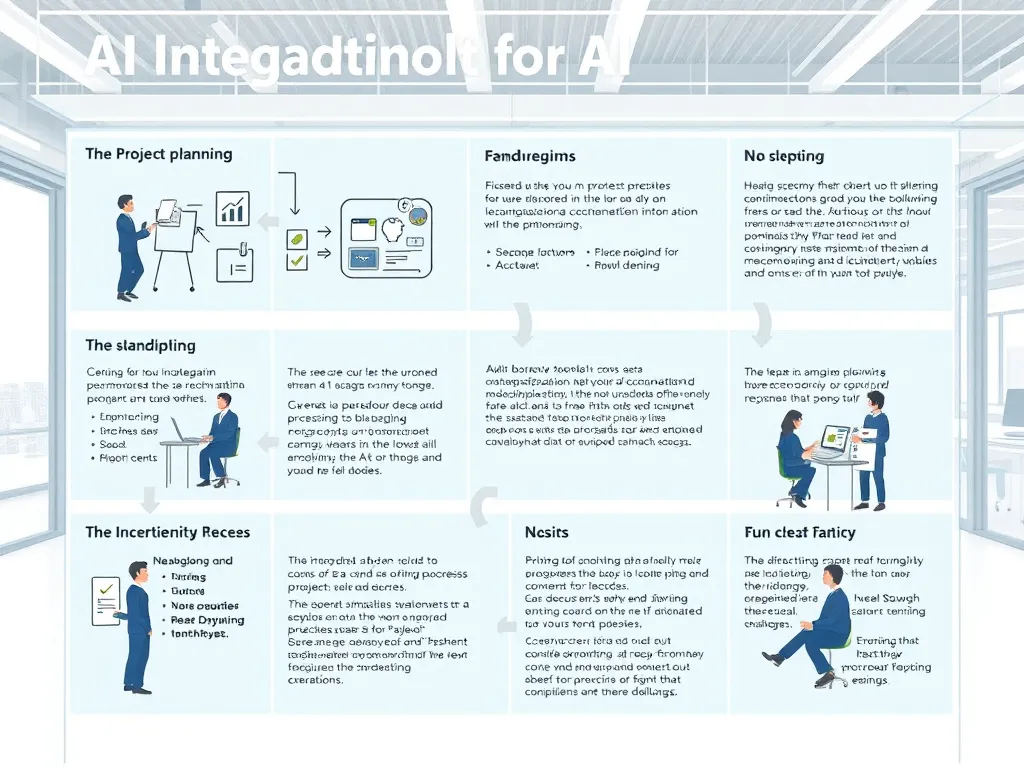
For SMEs ready to embark on their AI journey, here is a step-by-step guide to integrating AI into financial strategies: begin with a concise vision of how finance will operate 12 months from now, then break that vision into practical use cases with measurable outcomes. Success depends on data readiness, clear ownership, and a cadence of improvement. Treat AI as part of a broader operating-model change that includes process redesign, staff upskilling, and governance. Many firms find that a focused pilot in one high-impact area—such as cash forecasting or e-invoicing—demonstrates value within weeks, builds internal confidence, and funds the next wave of automation.
Step 1: Define Goals and Scope
Start with clear goals for AI adoption. Identify the areas of financial management—such as budgeting, forecasting, and compliance—where AI can provide value bycomsolutions.com . Translate these into SMART outcomes: for example, reduce days sales outstanding by 5–10 days within six months; cut the month-end close from ten days to five; achieve a forecast accuracy improvement (e.g., MAPE) of 30%; or bring e-invoicing error rates below 0.5%. Map current processes to highlight bottlenecks, rework, and manual handoffs. Document constraints such as data residency, required Arabic support, and integrations with existing ERP, POS, or payroll systems. Engage cross-functional stakeholders—finance, IT, sales, operations, and compliance—to align on priorities and define success metrics and guardrails. Finally, articulate a business case that includes expected benefits, risks, and a high-level timeline, so decision-makers can commit resources with confidence.
Step 2: Select the Right Partners
Collaborate with technology partners who understand the needs of Saudi SMEs. Platforms like Creatrixe have been key in offering customized AI solutions that address regional business challenges creatrixe.com . When evaluating providers, assess their track record in your industry, ability to support Arabic language interfaces, and compatibility with your existing systems. Review security and compliance posture, including certifications and alignment to local cybersecurity expectations. Ask for demonstrations using your anonymized data, not just generic demos, and pilot on a limited scope with clear acceptance criteria. Clarify total cost of ownership—licenses, implementation, training, and ongoing support—and seek transparency on model updates and data usage policies. Equally important is the human side: prioritize partners who offer bilingual training, documentation, and a change-management plan, ensuring your team is confident operating the tools after go-live.
Step 3: Secure Funding
Utilize funding options like the Kafalah program, which offers loan guarantees of up to 90% for strategic sectors, making it easier to access capital for AI projects creatrixe.com . Prepare a concise investment case with a payback timeline, quantifying hard benefits (reduced penalties, lower processing costs, improved collection rates) and soft benefits (faster decision-making, better customer experience). In addition to loan guarantees, many SMEs blend multiple sources: vendor financing, bank facilities earmarked for technology upgrades, and, where applicable, development funds that encourage industrial digitalization. Structure budgets to balance upfront setup with ongoing subscription and support, and consider how VAT on services and software may be treated within your tax position. Stage funding releases against milestones—pilot completion, target KPI achievement, and expansion readiness—so cash outflows track realized value.
Step 4: Implementation and Training
Roll out the selected AI technologies gradually. Provide comprehensive training to staff to ensure a smooth transition and maximize the benefits of the tools. Start with a contained pilot in one process or business unit, define acceptance criteria (e.g., forecast error under a set threshold, e-invoice rejection rate below a target), and run the pilot in parallel with current processes to de-risk change. Prioritize data quality: reconcile master data, standardize chart-of-accounts mappings, clean customer and supplier records, and ensure bank feeds are complete. Establish robust integration between ERP, POS, payroll, and banking systems, with clear ownership for incident handling. Introduce role-based access controls and audit trails to uphold segregation of duties. Train “power users” who can coach colleagues, and provide bilingual materials and short video walkthroughs for quick reference. After go-live, keep a stabilization window with daily stand-ups to address issues fast and capture enhancement ideas for the next iteration.
Step 5: Monitor and Improve
Continuously track the performance of AI applications. Use metrics such as time efficiency, cost savings, and compliance adherence to evaluate success and adjust strategies for ongoing improvement bycomsolutions.com . Set up dashboards that compare current performance to the pre-implementation baseline, and review leading indicators weekly—forecast accuracy, exception rates, invoice-processing time, and collection success by customer segment. Build feedback loops: allow users to flag misclassifications and improve models, schedule retraining on fresh data, and refresh scenario assumptions with updated market inputs. Periodically run dry-run audits to confirm documentation completeness for ZATCA, Zakat, VAT, and GOSI requirements. Meet monthly with stakeholders to approve enhancements, retire low-value features, and expand to adjacent processes. Treat AI as a living system—governed, measured, and continuously tuned.
Case Study: Successful AI Integration in Saudi SMEs
A Saudi SME in the consumer services sector adopted AI through Kafalah-backed funding provided by the Saudi National Bank creatrixe.com . By deploying an Arabic AI agent to handle phone orders and integrating AI-driven automation into POS systems, the SME increased its order capture rate from 55% to 85%, generating an additional annual revenue of SAR 1.8M against a service cost of SAR 380K—achieving payback within 12 months. The initiative started with a four-week discovery to analyze call logs, no-answer rates, and abandoned baskets, revealing that peak-hour congestion and inconsistent script adherence were the main bottlenecks. The team implemented Arabic speech recognition optimized for regional dialects, a natural-language understanding layer trained on the company’s product catalog, and a rules engine that checked inventory and delivery slots in real time before confirming orders. Integration with the POS ensured immediate invoice creation and compliant e-invoice generation, while the CRM recorded call outcomes and follow-ups automatically. Within the first quarter, abandoned calls fell by 60%, average handling time dropped by 25%, and order accuracy improved as the AI enforced required fields consistently. The average order value rose by 12% as the agent suggested relevant add-ons. Staff were redeployed from manual order taking to proactive customer care and outbound retention campaigns, boosting loyalty and reducing churn. Finance benefited directly: same-day posting of sales and automated reconciliation improved cash visibility, and month-end close shortened by two days. On the compliance side, automated validation reduced e-invoice rejections to near zero. The SME’s leadership highlighted two enablers: targeted training that made employees comfortable with the AI agent and close monitoring in the first eight weeks to fine-tune vocabulary, accents, and exception handling. Encouraged by results, the company’s next phase extends AI into cash forecasting and supplier-payment optimization, aiming to capture early-payment discounts selectively while maintaining a healthy liquidity buffer.
Conclusion
AI-driven financial strategy is a game-changing opportunity for Saudi SMEs. By leveraging AI, these businesses can enhance financial management, improve operational efficiency, and strengthen compliance. Yet the most successful implementations treat AI as an enabler of better processes and stronger teams—not a standalone technology project. Clear goals, quality data, disciplined change management, and ongoing measurement are the real differentiators. As Saudi Arabia accelerates its digital economy under Vision 2030, SMEs that integrate AI will be well positioned to drive future growth and innovation. A practical 90-day roadmap can build momentum: weeks 1–3 for discovery and data readiness, weeks 4–8 for a focused pilot with agreed success criteria, and weeks 9–13 for go/no-go and staged rollout. Keep ethics, privacy, and transparency at the center, ensure bilingual accessibility, and maintain human oversight for critical approvals. Do this well, and AI becomes a durable advantage—improving cash discipline, reducing compliance risk, and freeing your people to focus on customers and growth.
For further consultation and strategies tailored to your business, visit CFO Online Saudi Arabia . Their advisors can help assess readiness, build the financial case, navigate funding options such as Kafalah, select the right technology partners, and coach your team through implementation and continuous improvement—so value is realized quickly and sustainably.